 Welcome back to the blog! In this post, I'm sharing a few of my favorite Bible journaling pages. As you know, God has given me a unique way to journal. For years, I would read the Bible and would think, "I need more. I want to dig deeper, or I want what I'm reading to stick." During that time, the Holy Spirit spoke to my heart and led me to begin creating strategies for Bible journaling using reading comprehension skills. I would sit on the carpet and come up with ways for me to organize and understand the word more clearly. Here are a few: 1. Below is an image insert. I sometimes use images to help me better visualize specific things in scripture. This one was my study of Exodus 28 about the high priest, their garments, and their role in Israel. I simply printed the image and wrote out how each part of the garment was described and their purpose. It better helped me better understand the chapter overall. 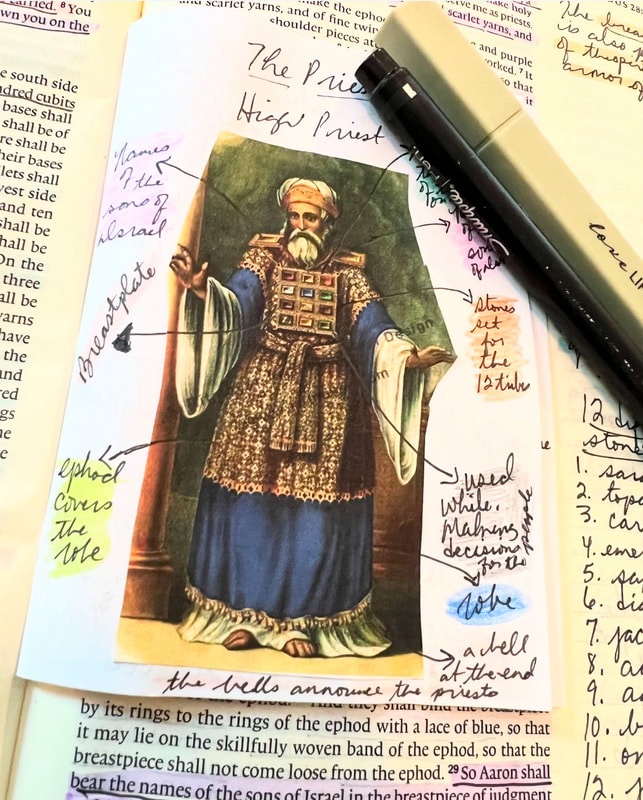 2. This next image is an insert of a graphic organizer I created. I am big on organizing the details from the scripture I'm reading, and this insert works so well. Organizing details is a reading comprehension strategy to help the brain process and understand the information better. 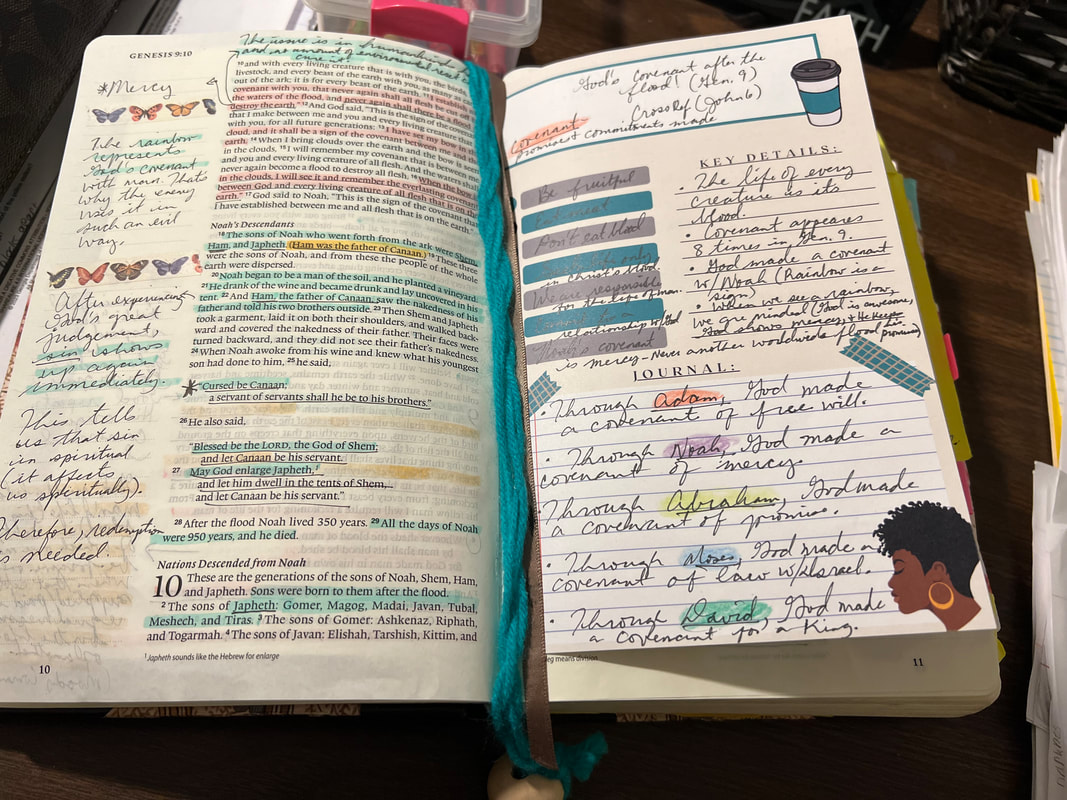 3. This strategy is one of my personal books. It is an acronym. I love creating and using acronyms. They are made with reading comprehension skills embedded in each of them. As you can see, I also love to decorate my pages with stickers and washi tape. These things are not a must while studying the word. They are just fun to use. 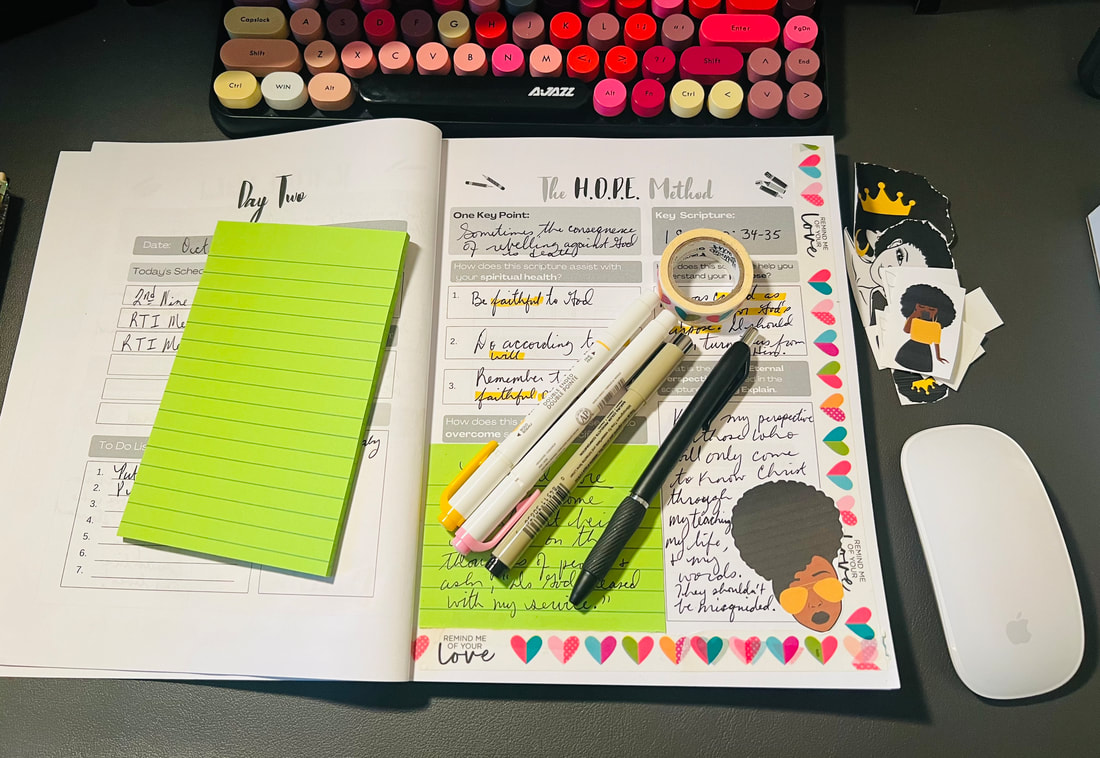 4. This is one of my digital journaling pages. Here I was studying Psalm 23:1. I did a deep dive research of a "shepherd." This is the vocabulary strategy of understanding figurative language. Here a metaphor is used, which is a comparison. I enjoy vocabulary focused studies. This is something I do often when I am studying the scriptures. Understanding the words in scripture are key to our overall comprehension. 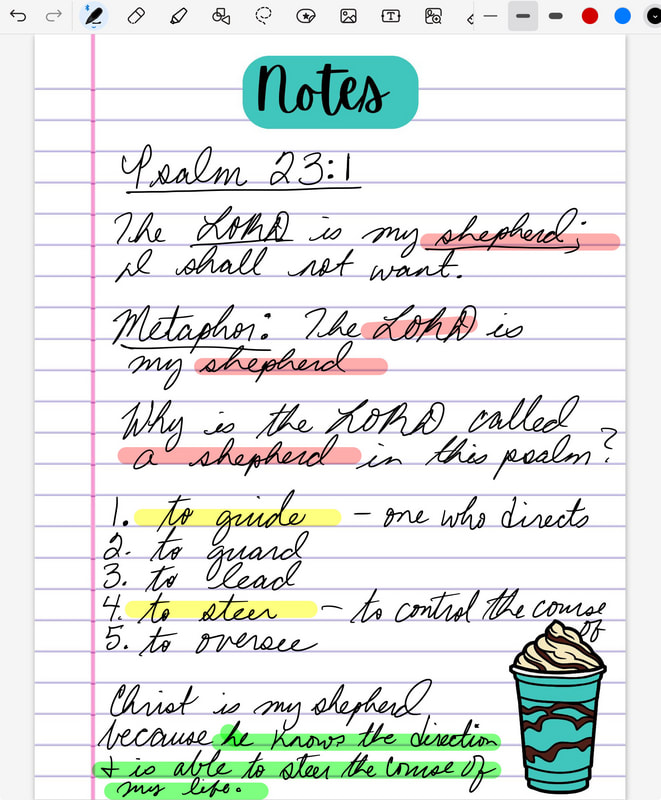 These are only a few of my journaling pages. I hope you enjoyed the previews of each one. I recommend you try journaling the scriptures. It has transformed my study time and helped build my biblical literacy.
Leave a question, comment, or share it with a friend. Be Blessed & Keep Studying with "Hope in CHRIST." Denise M. Walker Founder of HOPE-in-CHRIST Ministries
0 Comments
 Welcome back. We are now in chapter 5 of the book of Isaiah. This chapter goes deeper into God’s disappointment of the people of Israel and why He must bring about His righteous judgment. We will summarize this chapter using the classic (Who? What? When? Where? Why? and How?) strategy. Then we will dig deeper using our 4 questions (I changed them up a bit).
Summary of Chapter: Let's begin with the summary. Who? Isaiah is writing about his beloved's (The LORD's) vineyard on a very fertile hill. The vineyard is the house of Israel, the men of Judah, the plant the LORD delighted in. Who is Isaiah addressing? Israel’s elite and the farmers who exploited the people. What? Isaiah's beloved had broken up the soil, cleared it of stones, and planted it with the finest vines. He built a tower in the middle of it and dug out a winepress there. The LORD speaks through Isaiah, “What more could I have done for my vineyard than I did? Why did it yield worthless grapes?" “Now, I will remove your hedge, and you will be consumed.” “I will tear down your walls, and you will (the vineyard) will be trampled.” “I will make you a wasteland.” There were physical vineyards in the hills of Judea. When? Bible commentary states that Isaiah prophesied during the years of 740-700 BC. There was an economic boom during the reign of Uzziah but before Assyria. Where? Judah and Jerusalem Why? Why did God plant them there (the Vineyard)? God had a future purpose for them, and He expected them to yield good grapes, but they yielded worthless grapes. Why is God now removing their hedge of protection? He expected justice but saw injustice instead. He expected righteousness but heard cries of despair. Because of their rebellion. Because they celebrate their sin and mock God (see verse 19). They call good evil and evil good and substitute darkness for light and light for darkness. They consider themselves wise, get drunk, acquit the guilty, and deprive the innocent. They have no fear of the LORD. Why did God have to judge them?
How? How will God carry out His judgment? He will send in a ruthless army, roaring like a lion (Assyria in 701 BC)
What Stood Out? What first stood out to me was the revealing of the free will. God placed them in the land and provided what they needed to prosper, grow, and be successful. However, the leaders and the people, in their own wisdom practiced injustice, rebelled against God's laws, and celebrated their sin. It is evident that God spoke to them through the prophets numerous times, but they refused to listen. God's righteous judgment also stood out to me. Many may wonder, "Why would God do such a thing as destroy a people or cause an evil enemy to come upon them." If we look closely at verse 16, "our holy God demonstrates his holiness through his righteousness," we notice that God shows that He's holy through His actions toward the evil that was taking place in the land. We also see in verse 24, "for they have rejected the instruction of the LORD of Armies, and they have despised the word of the Holy One of Israel." This means that as many times as God had spoken to get them to turn back, they chose their own way. They even went as far as mocking God (verse 19). Now, let's dive deeper: 1. What were the possible lies Israel believed? Much like the world today, they may have believed that the land belonged to them and they could do what they wanted to do in it. Also, they may have believed that they weren't accountable to anyone but themselves. 2. What was the real truth about God? The truth revealed in this chapter is pretty much repeated throughout 1-5. It is, "The earth and everything in it, the world and its inhabitants, belong to the LORD" (Psalm 24:1 CSB). Therefore, the people and the land of Israel belonged to God, and they chose to not walk in His wisdom, but in their own, which brought about moral confusion and injustice. People were suffering as Israel had suffered in Egypt. God raised up the deliverer (Moses), and He used him to lead them out of captivity. So, the only true God, who is holy, responded as such. He would make the land "whole" again by removing the evil and injustice. The LORD of heaven's armies changes not. The same way he brought about justice to those who practiced evil and walked in their own way then, he will do it again. We should never fear the evils of man, how they exalt themselves and attempt to create their own truths, and their own "Christ." Why? Because God sees and He hears. He will render justice to all who practice false religion and operate in evil, the leader and the citizen in the land alike. 3. How did the lies they believed impact their identity? They would go into exile as slaves of others. They would no longer be free with the LORD as their guide and protection, but they would be bound and homeless as a result of their sin. 4. What did they believe their purpose was in their current condition? Same as in Chapter 4. But there was still HOPE for them... Now use my HOPE acronym and journal how there was still hope for them by answering the questions below. Feel free to change or add your own questions as well. H (Spiritual Healing) - What spiritual fruit were they expected to produce? O - (Overcoming) - How could they turn back? P - (Purpose) - What are some examples of the things they did that distorted their godly purpose? E - (Eternal Perspective) - In verse 16, how did God need their perspective to change? Finally, take a few moments to journal at least one of the application questions below: 1. What has God done to provide a fruitful love relationship with Him? (Taken from the "Experiencing God Bible") 2. How does the following verses (choose one, two, or all of them) better help you understand Israel as a vine planted by God: Psalms 80:8-16; Jer. 2:21; Hosea 10:1-3; and John 15:1? 3. According to 1 Peter 1:14-17, how are we instructed to walk in holiness as God is holy? When you're finished, return here. My answer: I chose to answer #3. Verse 14 uses a simile (a comparison to an obedient child) as a visual representation of what holiness looks like. It states to not be conformed to the passions of one's former ignorance (ESV). The term conformed means to behave according to social conventions; to comply with rules or standards. In addition, the word passions means "desires or cravings." When we put this all together, we are instructed to walk as an obedient child would do when they are obeying their parents instructions at all times. The adjective "obedient" tells us how our lives should look. We are to not comply with what the world thinks or even our former desires, which kept us in bondage, but with what God instructs, knowing that He judges all, just as our parents would give consequences to us as kids. Leave a comment below with your answers to the questions. Also, leave any questions or other commentary. Be Blessed & Keep Studying with "HOPE in CHRIST" Denise M. Walker Founder of Hope-in-Christ Ministries 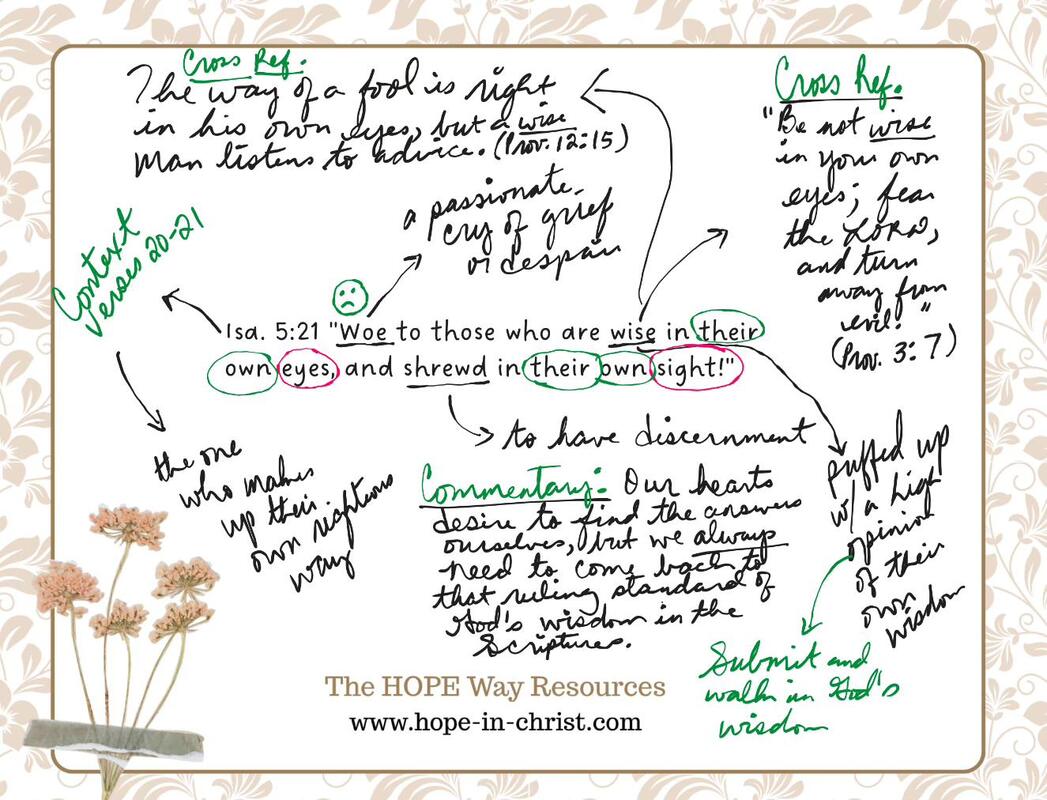 I know I'm a little out of order, but I was reading ahead in the book of Isaiah, and this verse jumped out at me. It fits out current time more than ever before. I decided to share how I break down a scripture. People often ask how I create my Bible study resources—this is it. This is what Bible study looks like for me as an English/reading teacher. It all began with me wanting/needing to dig deeper. When I open Scripture, I approach it the same way I would a challenging text in my classroom. I slow down, gather the essential background information as needed, annotate, and ask questions as I’m reading. I let the words guide me instead of rushing to conclusions. In other words, I use literacy strategies to study Scripture. In the Isaiah 5:21 example, I followed the repeated idea of being “wise in our own eyes” across Scripture. That led to a deeper understanding and a clearer application. I don’t believe Bible study has to be intimidating. It just requires slowing down, inviting the Holy Spirit in, and letting Scripture explain itself in context. That’s the heart behind everything I create—to make Bible study accessible and meaningful. Notes About the Scripture: As it relates to Isa. 5:21, we live in a world where many believe they are wise in their own eyes. However, the creator of heaven and earth is still all powerful, the giver of true wisdom and knowledge. When we seek our own wisdom separate from Christ, we are operating in our flesh, which causes us to idolize ourselves. But God is the giver of our very mind. Therefore, we must humble ourselves and fear the LORD as stated in Proverbs 3:7. No matter how the world walks in their own wisdom, we must draw near to Christ and seek His wisdom every second of the day. Be Blessed and Keep Studying with Hope in Christ! www.denisemwalker.com www.hope-in-christ.com  Welcome back! I'm truly enjoying this study in Isaiah. Although this poetic book is not the easiest to understand, it is relevant to our time. This week, we are zooming in on Isaiah 4. Keep in mind that our theme for the year is "wholeness," which can only be realized in Christ Jesus.
These scriptures in chapter 4 prophesy about the Messiah (who is the Christ). He is known as the "Branch of the LORD" in Isaiah 4:2 and in other places in the Old Testament. There are times during Bible study when our focus is drawn to one small phrase. This is the one that caught my attention. Therefore, we will only focus on this for this study. See the reference below: Isaiah 4:2 - "In that day the branch of the LORD shall be beautiful and glorious, and the fruit of the land shall be the pride and honor of the survivors of Israel. Now, as you know, the previous chapters remind us that the LORD will judge sin and rebellion because we are His creation, and the earth belongs to Him. However, Prophet Isaiah pauses in chapter 4 and shifts in this short chapter to remind the audience that there is HOPE, which is what we have included in our previous three studies. God allowed him to see a vision of the coming Christ, the redeemer. This was a time in the future of course. In addition, "in that day" points to the time of the end. For the previous 3 chapters, we began by summarizing the chapter but for this one we will do something a little different to look more closely at "The Branch of the LORD." The LORD uses my brain in unique ways. I'm always amazed by Him. He led me to use the letters in BRANCH to help us see Christ's purpose and work, not just for Israel, but for us all. In Isaiah 4:2, we see the branch shall be beautiful and glorious, which sounds like when He comes to reign in the future. Let's checkout some other places where "The Branch of the LORD" is mentioned: Jer. 23:5; 33:15-16 - "Behold, the days are coming, declares the LORD, when I will raise up for David a righteous Branch, and he shall reign as king and deal wisely, and shall execute justice and righteousness in the land. In his days Judah will be saved, and Israel will dwell securely. And this is the name by which he will be called: ‘The LORD is our righteousness.’" Zech. 3:8 - "Hear now, O Joshua the high priest, you and your friends who sit before you, for they are men who are a sign: behold, I will bring my servant the Branch." Isa. 11:1-5 "There shall come forth a shoot from the stump of Jesse, and a branch from his roots shall bear fruit. And the Spirit of the LORD shall rest upon him, the Spirit of wisdom and understanding, the Spirit of counsel and might, the Spirit of knowledge and the fear of the LORD. And his delight shall be in the fear of the LORD. He shall not judge by what his eyes see, or decide disputes by what his ears hear, but with righteousness he shall judge the poor, and decide with equity for the meek of the earth; and he shall strike the earth with the rod of his mouth, and with the breath of his lips he shall kill the wicked. Righteousness shall be the belt of his waist, and faithfulness the belt of his loins." These scriptures are powerful to say the least! As I read over them, I could see the power and authority of the Christ that would come, and the power of the Spirit would be upon Him. What a blessing to be able to see Him prior to His coming. God is amazing. Isaiah 4:2 speaks of a remnant (possibly: the survivors of the Exile) who would return to Israel in the land. It and the other scriptures noted above also reference Christ as the fulfillment of "the Branch" of the LORD (using the pronoun "he" in Jer. 23:5) who came from the line of David, had the Spirit of the LORD upon Him, had the Spirit of wisdom and understanding, and would judge the earth with righteousness. Side note: Early in my walk with Christ, I remember reading the book of Isaiah for the first time. Honestly, I understand it much more now than I did back then. I was so confused I assumed he lived during the time of Christ because he was so specific in his prophecies. Now, I understand that God in a greater way. He has the ability to show us what He chooses, in the distant future or the present. That's what makes it so amazing to know that He is the truth. Back to the study. Now that we have taken a closer look at "the Branch" we now know as Lord and savior, let's use those letters to summarize His work in the earth and our lives: Christ is the B.R.A.N.C.H. of the LORD: He is the… B - is the righteous branch sent from God, sprung up from the root of Jesse R - was sent to redeem the souls of man from the sin we once walked in and to make us righteous as we place our trust in Him A - is the anointed one, appointed to bring restoration Israel and the earth N - draws souls from the nations and teaches them God's way C - cares for justice and his wisdom is evident H - holds the wicked accountable into eternity As I reflect on the words above, I am thankful for finding the truth in Christ. There are so many ways you and I could have gone, but the power of God led us in His direction, and we must help others to turn towards Him as well. Only the true and living God can bring such an amazing gift to us, to save and redeem. No matter how the world turns, remain in Christ and keep telling others about Him. He wins and will be glorified in the end. Now, let's dive deeper: This time, our questions will be focused on Christ, not Israel. We will take a few minutes to answer the 4 questions below. You can use your Bible or a journal. Once you're done, return here for the next part. 1. What lies does our world today believe about Christ? Some believe the prophecies are made up. Some believe He never existed. Some believe He was just a prophet. Some believe there is more than one way to God. 2. What truth about Christ do they question? He is the Son of God. All things were made through Him. He has all power in His hands. He is the way, the truth, and the life. He died on the cross and rose again with all power in His hands. 3. How do the lies they believe distort their identity? This causes them to seek other ways to God. This causes some to live life not knowing who they are. They then take on false identities. 4. What do they believe their purpose is in that distorted identity? Some believe their purpose is to live by their own "truth" and do whatever feels right to them. They would chase after their identity in things. But Christ is our HOPE... Now use my HOPE acronym and journal how Christ (the righteous branch) became our HOPE. Use the questions below to assist you. Feel free to change or add your own questions as well. Also, look up cross reference scriptures to help you answer in detail. H (Spiritual Healing) - How does Christ heal us spiritually? O - (Overcoming) - How does He cause us to overcome the lies we might find ourselves believing about Him? P - (Purpose) - How is our purpose fulfilled in Christ? E - (Eternal Perspective) - How does the renewing of our mind in Christ give us an eternal perspective? Instead of answer application questions, grab your journal and write your own summary about "the righteous Branch" of the LORD using the letters from the word. Extra Journaling idea: Dig deeper into the metaphor. What is the purpose of a physical branch? How does its purpose relate to Christ and what He came to do for humanity? Feel free to leave a comment or a question on the blog. Also, share your answers to the questions. Be Blessed & Keep Studying with "HOPE in CHRIST” Denise M. Walker Founder of Hope in Christ Ministries  Welcome back. As we continue in the book of Isaiah, let us consider if we are truly following the LORD with our whole heart or the ways of man. This week, we are taking a look at Isaiah chapter 3. Remember, our theme for the year is "wholeness" and remembering that there is still HOPE. See the previous posts for definitions and commentary on the theme.
Between chapters 1-3, we see a pattern of those who had turned from the LORD and followed others. As a result, they would lose resources and provision from the LORD. Let’s jump into the specifics of chapter 3. We will start with summarizing the chapter. This chapter starts out with God removing food and leadership from Jerusalem and Judah because they were not ashamed of their sin and they trusted in others more than God. Prophet Isaiah then began to give the specifics of those who would be removed. Next, he explained to them that God would replace them with “boys and infants,” which is a metaphor for those who are not responsible or mature. This would bring about chaos and unrest. It would also cause the people to oppress one another. Finally, he explains that the LORD would take away the wealthy garments of the prideful women because they flaunted their pride and sin. Everyone would mourn. The verse that stood out to me was verse 24, “Instead of perfume there will be rottenness; and instead of a belt, a rope; instead of well-set hair, baldness; instead of a rich robe, a skirt of sackcloth; and branding instead of beauty.” This verse spoke to my heart. The word "instead" continued to leap from the page. This was a great warning for the women of the land. Although, God addresses the entire nation as a whole, the pride in the women stood out like a brightly lit billboard on a long dark road. What happens to a society when even the women, the nurturers get to such a stage of sin? It collapses. Being a woman, a wife, and a mother, these verses about the women make me think about the conditions of the children’s hearts during that time. If those who were called to train up the children (the men and women alike) had turned from God, there is no one else to lead the young people. I imagined the children following their wickedness and their idol worship. In addition to verse 24, verse 4 also stood out to me, “And I will make boys their princes, and infants shall rule over them.” As stated in the summary, God even spoke through Prophet Isaiah that he would replace their leaders with children. I saw this not as God being harsh toward children, but that He was revealing to them how far they had fallen, no one was leading in the way of the LORD anymore, so to make them aware of their current spiritual condition, He would give them those who were not fit, not just lead them, but also to Lord over them. I believe this was to open their eyes in hopes that they would come to know that they needed to return to the LORD’s truth, guidance and direction, and away from the evil guides they followed. This was all a result of their great pride and becoming rich by taking from the poor. They flaunted their sin before God, not realizing that they were barren, seeking greatness and riches, but they were empty without the LORD. The evil in their society had come to a head, and God would deal with it and cause them to experience humiliation in the process. Some would probably not see the consequences of their sin as the grace of God, but that’s exactly what it was. Now, let's dive deeper: As usual, we will take a few minutes to answer the 4 questions below either in our Bible or a journal. Once you're done, return here for the next part. 1. What lies did Israel believe? They believed that their resources, wealth, magic, and leaders would bring them success. The women believed their status and wealth was their identity. They believed their guides would lead them in the right direction. 2. What was God's truth they questioned? God is their true leader and guide. 3. How did the lies they believed distort their identity? This distorted their identity because their achievements, appearances, and status became more important. They became experts in things that were not of God, instead of God's praying people. 4. What did they believe their purpose was in that distorted identity? I think they believed their purpose was to build their status by any means. But there was still HOPE for them... Now use my HOPE acronym and journal how there was still hope for them by answering the questions below. Feel free to change or add your own questions as well. H (Spiritual Healing) - How would their spiritual health improve when God removed their support and supply (v. 1-3) and enters into judgment with the elders and princes? O - (Overcoming) - How will God respond to the righteous in the land? P - (Purpose) - What do you think was God's real purpose for the women in the land? E - (Eternal Perspective) - Why is God trying to shift their perspective to an eternal one? Finally, take a few moments to journal at least one of the application questions below: 1. What are the signs that your nation is in danger of God's judgement? (Taken from the "Experiencing God Bible") 2. How does poor leadership result in the suffering of the poor and vulnerable? (Taken from the "Experiencing God Bible") 3. How does James 5:4-5 relate to this chapter? When you're finished, return here. My answer: The question I chose to answer is #1. The signs that a nation is in danger of God's judgment is the same as those things taking place in chapters 1-3. I list a few of them:
Junk Journaling idea: I also love to junk journaling in my free time. Here is a simple idea to help us meditate on God's words from Isaiah 3: Print out pictures of Jenga blocks or draw them (for those who are artistic). Make sure some of them are standing with missing blocks and some are scattered across the page. Next, add note bubbles that explain that the fallen blocks represent a society that has collapsed because of God's judgment. Include how they collapsed as well. On another page, write a prayer for our nation and those around the world. Make sure the prayer includes repentance and praying for the nations to return to God. Please leave a comment below with your answer to the question you chose to answer and an image of your spread if possible. Also, leave any questions or commentary. Be Blessed & Keep Studying with "HOPE in CHRIST” Denise M. Walker Founder of Hope in Christ |
“Where literacy strategies meet Scripture.”AuthorDenise M. Walker is the founder of 

CategoriesArchives
June 2026
|
 RSS Feed