 Well, here we are. Are you ready, ladies? I hope so because I am. Before we begin our Bible study for 2026. Please take a minute to read the reminders below:
Let's begin. Read: Isaiah Chapter 1. On your own, read/listen to Isaiah chapter 1. Don't rush through it. I suggest reading and listening to it more than once. Then, write a quick summary describing what the chapter was about overall. When you are done, return here. Strategy: Now that we have read Isaiah chapter 1, here is my short summary: Prophet Isaiah was speaking to the leaders and the people of Israel about their rebellion and iniquity. They had "forsaken and despised" the LORD, resulting in them only practicing religion, oppressing, and even murdering. God would purge the evil from among them and restore them as before, and those who didn't repent would be consumed. In chapter 1, the verses that stood out to me were 21-31. These stood out because Prophet Isaiah explained (in detail) the causes of their barren condition. I sorted his statements using "cause and effect." This is a simple reading strategy that can help with a deeper understanding. I completed this T-chart in OneNote. See image below. 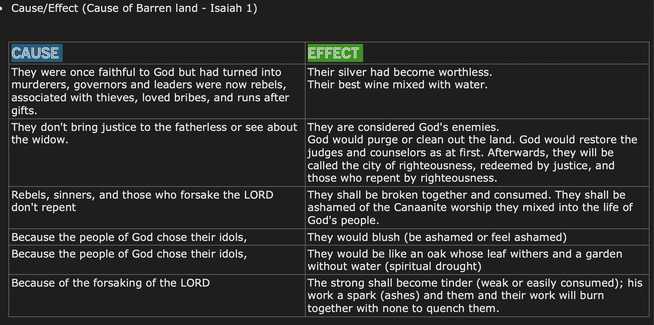 Now, let's dive deeper:
Take a few minutes to answer the 4 questions below either in your Bible or a journal (before reading what I have written). Once you're done, return here and compare notes. 1. What lies did Israel believe? I think Israel believed that God was insignificant or like the false gods that man created. Maybe they believed that God wasn't all-powerful. Finally, God may not have been the final authority in their lives. 2. What was God's truth they questioned? God sees and hears. God is all-knowing. He's the only one who can save. Everyone will give an account of himself to the God who made us (Romans 14:12). 3. How did the lies they believed distort their identity? According to the text, they became evil doers, corrupt, rebels, liars, and thieves. People with no morals. They were filled with pride and desired other sources that couldn't save them. Overall, it was all about self. This was not God's will for their lives. 4. What did they believe their purpose was in that distorted identity? "Everyone loved bribes and ran after gifts. There was no justice for the widow or the fatherless." In other words, their purpose was to get all they wanted in life and live their lives on their own terms, no matter who they harmed in the process. Regardless if it made God angry. But there was still HOPE for them... Now I want you to use my HOPE acronym and journal how there was still hope for them by answering the questions below. Feel free to add your own questions as well. H (Spiritual Healing) - What was God's plan for spiritual healing? How did He instruct the people to participate in their healing? O - (Overcoming) - To overcome their separation from God, what did they have to do that included their free will? P - (Purpose) - What did God say they once were, which was His purpose for them? E - (Eternal Perspective) - How was their perspective different from God's divine perspective? Finally, take a moment to journal at least one of the application questions below: What lesson was God teaching in this chapter? How does it relate to you personally? How will you apply what you've learned to your own life? When you're finished, return here. My answer: 1. God was teaching that we are His creation, and He sustains us. 2. This relates to me personally as a parent. It helps me to always remember the LORD's position in my life, first. I always think in analogies. For example, when our children are growing up, they come to us when they are sick, in need of food, or money for school. They are aware that we are the ones who care for and sustain them through God's grace. Side note: I am aware that this is not everyone's story. I'm only connecting it to my personal experience as a parent. 3. I will apply this by remembering that God is holy and He made me, not for myself, but for Him—to live holy, set apart of Him. Be Blessed & Keep Studying with "HOPE in CHRIST" Denise M. Walker
0 Comments
Your comment will be posted after it is approved.
Leave a Reply. |
“Where literacy strategies meet Scripture.”AuthorDenise M. Walker is the founder of 

CategoriesArchives
June 2026
|
 RSS Feed