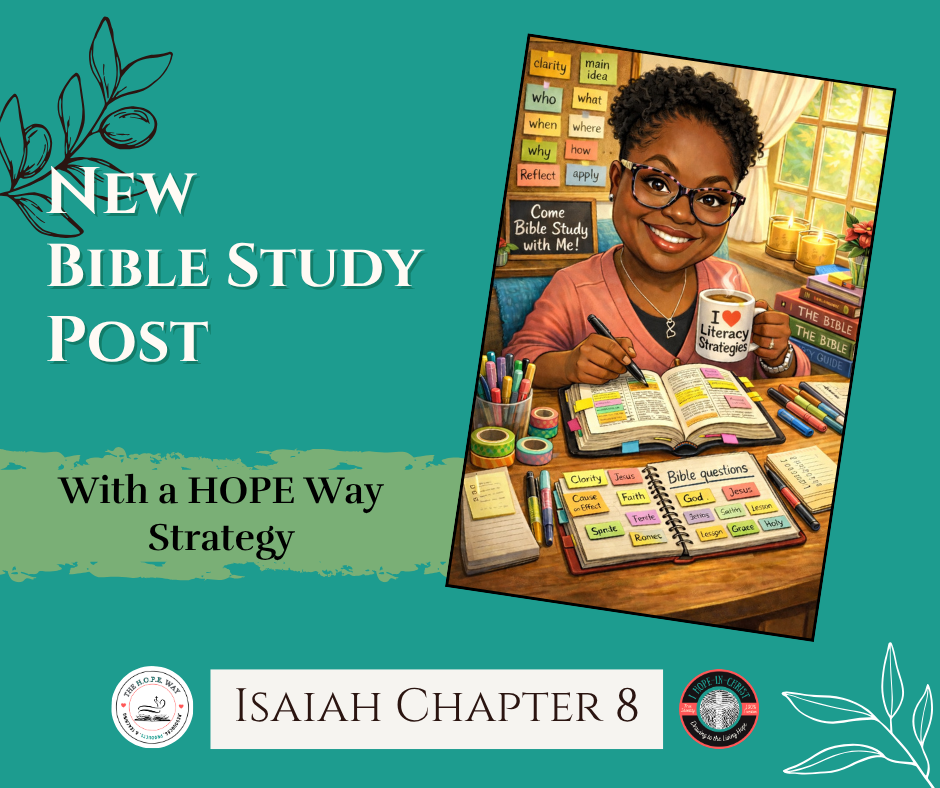
 Welcome back to the Come Bible Study with Me Blog. We are pressing forward through the word in the book of Isaiah. As you have probably noticed, it is taking time to deeply study this amazing book. This is how we should study, slow down and get the true message. In many instances Prophet Isaiah is seeing present and future and there is some symbolism also, so we want to be sure we understand the parts clearly. Remember context is very important.
I will continue using the asking questions (annotating strategy) to summarize this chapter. I pray you are enjoying this strategy as much as me. A few of the Bible study resources I am using while studying are www.biblehub.com, the Experiencing God Bible, and the Olive Tree Bible app. These resources help me to deep dive into the context, background, and to also look up the words for understanding. In addition, I use the YouVersion app to listen to the text more than once if needed. It's important that we reread and use scholarly resources to help us better understand the parts of the scripture where we get stuck. Let's jump into chapter 8! Here are my list of questions and answers I came up with as I read through the chapter: How many sections are in this chapter? This chapter is broken into 2 sections, "The Coming Assyrian Invasion (1-10)" and "Fear God, Wait for the LORD (11-22)." How was Isaiah's life a sign to the people that God is real and was all they needed? Isaiah's name alone meant "Yahweh is salvation." In addition, he followed all of God's instructions. He remarried a virgin after his first wife passed away. His sons' names were given prior to God bringing to pass what he had spoken through Isaiah. They were physical signs of remembrance of God's power and truth. In section one, what do the waters of Shiloah -vs- the mighty river of (Euphrates) Assyria represent? According to the ESV study Bible in, Shiloah was a quiet spring feeding Jerusalem—a picture of God's steady, faithful care. In contrast, Assyria was a roaring flood of empire politics. Its military power would flow over Syria and Ephraim and flood south into Judah as well, causing destruction. In section one, why did they prefer the "Euphrates?" Maybe because the Assyrians were seen as a world superpower that everyone feared. Maybe they believed they had drawn far away from God where they were not hearing his voice or they thought the situation was bigger than the LORD. In section one, why does Isaiah say, "Give ear all you far countries; strap on your armor and be shattered?" Well, the simple answer is in verse 10, "For God is with us." Because of this truth, no one would completely destroy them, no matter how powerful the Assyrians believed they were because of the power and authority of God himself. In section 2, what does God mean when He instructs Isaiah to not walk in the way of the people around him? God tells Isaiah to honor Him instead of fearing what others could do to Him. I believe He is making Isaiah aware that there shouldn't be any idols in his life. If he feared the power of the Assyrians so much as to join forces with them to keep them from destroying them was equivalent to bowing to an idol as a god. He needed to trust God and watch God move on their behalf. In section 2, verse 14, what does "he will become a sanctuary and a stone of offense and a rock of stumbling to both houses of Israel…?" This is a prophecy about Jesus Christ. I did a little digging about these phrases, and I found some profound details. According to Professor David Chapman at Covenant Theological Seminary, Christ's crucifixion and being the Messiah were stumbling blocks (obstacles, hindrances, or barriers) to the Jews. One reason was because people who were hung on trees were considered "cursed" by God. They were rebels, slaves, robbers, etc.). Therefore, they wouldn't be able to understand how one who seemed to be cursed by God and had undergone the same death by the enemy's of the Jews was a savior for them. Most Jews of the first century expected a powerful, conquering Messiah who would liberate Israel from Roman rule and restore the Davidic kingdom. In section 2, why would the people inquire of the mediums and necromancers? I believe they considered this to be a short cut to placing their trust in God. Maybe they wanted to follow after others' practices. Either way, they wanted to come up with the solution on their own, which God won't violate. This is why the LORD instructed Isaiah (who loved Him and obeyed Him) to not follow what the others were doing. They had a free will. In section 2, what does "they have no dawn" mean? This means, without relying upon and turning to God's wisdom and truth, they will be in spiritual darkness, distress, and gloom. This is the consequence of ignoring God. What stood out the most? The thing that stood out to me the most was how God sent Isaiah to the people knowing they would still refuse his words and warnings. God did everything to reveal himself to them, but they rejected Him over and over. This, to me, shows God's grace and mercy while at the same time not violating their free will. It also reveals His plan for redemption (Christ) that he spoke through Isaiah. What's the theme of this chapter? I think the theme of this chapter is "Despite the judgment and correction of God, He is still merciful, even when we don't deserve it." How does it apply to us today? I think many today must stop seeking the answers from self and others. They must seek to understand the Ancient of Days in the context of scripture, understand his character, and his truth in order to truly be free. I think we must denounce the idols we fear because they are not bigger than the LORD of hosts. We must hold to faith in the LORD as Isaiah, not superficial but life-preserving. Now, let's dive deeper: The 4 questions will focus on the people of the land this time. Once you're done, return here for the next part. 1. What lie did the people believe? The people believed that they could overcome trouble in their own power and strength. King Ahaz didn't ask God's help because he had sought the help of the help of the Assyrians. They also believed they could get support from mediums and necromancers, which is why Isaiah said, "Should not a people inquire of their God?" They were speaking to the dead who know nothing, instead of seeking the God who made them. 2. What truth did God reveal about Himself to the people? He revealed that He is all-knowing. He told them (through Isaiah) that He knew their ways, yet He attempted to extend grace to them in the prophecy that was fulfilled in Isaiah's son. God went through lengths to show Himself to the people, but they still rejected Him. 3. How did the lie they believed distort their identity? It distorted their identity by giving them a false hope in themselves. They were nothing without the God who brought them out of the bondage of Egypt and kept them from being destroyed by the evils around them. 4. What was their purpose as revealed to them by God? Their purpose was to honor and worship the God who created and sustained them. Now use my HOPE acronym and journal how there was still HOPE for them by answering the questions below. Feel free to change or add your own questions as well. H (Spiritual Healing) - In chapter 8, how did the people's misplaced trust affect their relationship with God and their deliverance from the wickedness in the land? O - (Overcoming) - What hope did God's presence offer even though judgment was coming? P - (Purpose) -What does Isaiah's faithfulness teach us about remaining committed to God's purpose even when others reject Him? E - (Eternal Perspective) -Why was trusting God's promises a greater source of hope than trusting political alliances or human wisdom? Finally, take a few moments to journal the application question below: In what area of your life is God calling you to stand firm and remain faithful? What were your answers from this chapter? Add them and the answers below and any other comments you have. Share this with someone else. Thank you for stopping by the blog! Be Blessed & Keep Studying with "HOPE in CHRIST" Denise M. Walker Founder of Hope-in-Christ Ministries
0 Comments
Your comment will be posted after it is approved.
Leave a Reply. |
“Where literacy strategies meet Scripture.”AuthorDenise M. Walker is the founder of 

CategoriesArchives
June 2026
|
 RSS Feed